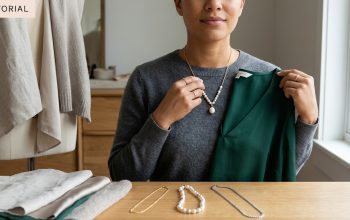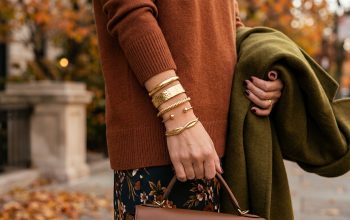
Mixing gold and silver jewelry effectively relies on establishing visual priority rather than splitting your pieces down the middle. When yellow gold and silver share equal visual weight, the combination often looks like an accidental oversight. By anchoring your look with a single dominant metal, using a mixed-metal connector, and matching the scale of your pieces, you create an intentional outfit detail that works across different necklines, fabrics, and occasions.
Establish a 70/30 Dominant Metal Ratio
An equal 50/50 split between gold and silver creates visual competition because neither metal serves as the baseline. Establishing one metal as roughly 70% of your visible jewelry anchors the look, while the remaining 30% acts as a purposeful contrast.
Selecting your dominant metal depends on the rest of your outfit:
- The 70% Base: Use your primary metal for your largest or most structural pieces, such as a thick chain necklace, wide hoop earrings, or a structured cuff.
- The 30% Accent: Restrict your secondary metal to smaller, secondary focal points. If your base metal is yellow gold, a thin silver band stacked next to a gold ring or a delicate silver pendant chain provides crisp contrast without washing out the warmth of the gold.
For example, wearing a solid yellow gold chain and gold hoop earrings establishes gold as your foundation. Adding two narrow silver bands on your index finger registers as a deliberate design choice rather than an uncoordinated mix.
Anchor the Combination with a Two-Tone Bridge Piece
A bridge piece contains both warm gold and cool silver in a single design. It serves as visual context, making single-metal pieces elsewhere on your body feel connected rather than mismatched.
Effective bridge pieces include:
- Two-Tone Watches: Timepieces featuring alternating stainless steel and gold links bridge a silver bracelet on one wrist with gold rings on the opposite hand.
- Interlocking Band Rings: Intertwined silver and yellow gold bands unify separate silver and gold rings worn on adjacent fingers.
- Mixed-Metal Chains: Necklaces constructed with alternating gold and silver links instantly harmonize layered single-metal chains.
Position your bridge piece at a high-visibility point—such as your wrist or hand—where it naturally sits alongside your single-metal pieces. Purchasing a single, high-quality bridge piece is far more effective than buying multiple low-cost two-tone items, as one clean anchor is enough to ground your entire collection.
Align Scale, Weight, and Surface Finish
Mixing metals succeeds when the underlying design language remains consistent. Pairing a delicate gold threader earring with a heavy, wide silver collar necklace creates awkward visual tension because the weights and proportions conflict, regardless of their colors.
Match Visual Weight
Keep the scale consistent across both metals:
- Fine and Minimal: Pair fine gold snake chains with narrow silver box chains or thin stacking bands.
- Chunky and Sculptural: Pair thick gold dome rings with heavy silver signet rings or solid cuffs.
Balance Surface Textures
Varying the finish of your metals can soften the visual jump between warm gold and cool silver:
- High-Gloss Pairs: High-shine polished gold paired with polished sterling silver creates a sharp, modern, high-contrast look suitable for crisp tailoring.
- Textured Pairs: Combining brushed or matte yellow gold with oxidized or vintage sterling silver subdues the contrast, yielding a softer finish that pairs well with heavy knitwear or casual linen.
Account for Coat Zippers, Buckles, and Bag Hardware
Jewelry does not exist isolated from the hardware on your clothing and accessories. Metallic elements built into your garments act as part of your overall metal ratio.
Evaluate your functional hardware before picking your daily jewelry:
- Outerwear: Prominent chrome zippers on a leather jacket or polished brass buttons on a navy peacoat establish an immediate metal presence. If your trench coat features bright silver buckles and zippers, choosing silver as your 70% dominant metal keeps your jewelry aligned with your outerwear.
- Handbags and Belts: A handbag featuring a gold chain strap or a belt secured with a heavy silver buckle acts as a visual anchor. Matching your primary jewelry metal to your bag clasp or belt buckle allows your secondary metal to appear in smaller, intentional accent pieces.
Coordinate Metals with Skin Undertones and Fabrics
While personal preference always dictates what you wear, selecting your dominant metal to match your skin's undertone and fabric selection produces a cleaner aesthetic overall.
Skin Undertones
- Cool Undertones (Pink, red, or bluish undertones): Using silver or white gold as your 70% base metal complements cooler complexions, while yellow gold accents introduce warmth.
- Warm Undertones (Peachy, golden, or olive undertones): A yellow gold base enhances natural warmth, while sparse silver accents add crisp structure.
- Neutral Undertones: You can alternate dominant metals freely based on your apparel palette.
Fabric Pairings
- Cool Neutral Textiles (Navy, charcoal, slate, crisp white): A primary silver base maintains clean structure against cool-toned fabrics, while gold accents inject warmth into cold background colors.
- Warm Neutral Textiles (Camel, cream, chocolate brown, forest green): Rich yellow gold bases ground soft, warm knits, while silver accents add a modern contrast to deep earth tones.
Mixed-Metal Placement Guide
The strategy below outlines practical placement combinations across key points on the body.
| Body Area | Dominant vs. Accent Application | Practical Styling Rule |
|---|---|---|
| Neckline | Layer a medium-weight gold chain (base) with a thinner silver pendant chain (accent). | Stagger chain lengths by at least two inches so pendants do not rest directly on top of each other. |
| Wrists | Wear a two-tone watch anchored by two gold bangles and one simple silver cuff. | Group items tightly on one wrist rather than balancing single-metal bracelets symmetrically across both arms. |
| Hands & Fingers | Stack a wide gold band on one hand alongside narrow silver stacking rings on the opposite hand. | Include at least one mixed-metal ring or bridge band to connect left and right hand stacks visually. |
| Ears | Wear gold huggie hoops in primary lobe piercings with simple silver studs in upper lobe or helix piercings. | Place the heavier, dominant metal in lower lobe piercings and lighter accent metals higher up the ear. |
Where Mixed-Metal Styling Fails (and How to Fix It)
Even straightforward rules can break down in practice. Recognizing common friction points helps keep your styling crisp.
Over-Clustering at a Single Point
- The Conflict: Wearing four mixed-metal rings on one hand while leaving your ears, neck, and opposite wrist completely unadorned creates an unbalanced silhouette.
- The Solution: Distribute your accent metal to at least one secondary point on the body. If you wear stacked mixed-metal rings, wear simple silver studs or a gold pendant to distribute the visual weight.
Clashing Design Eras
- The Conflict: Pairing an intricate vintage gold filigree pendant with a minimalist, geometric silver cuff necklace creates stylistic friction that metal color alone cannot fix.
- The Solution: Maintain architectural consistency. Pair vintage gold pieces with oxidized or antique-finish silver, and reserve high-gloss geometric silver for contemporary, polished gold items.
Ignoring Gemstone Settings
- The Conflict: Brightly colored gemstones set in sterling silver prongs can clash if worn alongside warm yellow gold chains that fight the gemstone's underlying hue.
- The Solution: Count colored gemstones as active elements in your color palette. Pair cool-toned gems (sapphire, emerald, tanzanite) with dominant silver, and warm-toned gems (garnet, citrine, amber) with dominant yellow gold.
Wardrobe Audit: Evaluating Your Collection Before Buying
Before purchasing new jewelry to attempt a mixed-metal look, audit your current wardrobe to identify what you actually need.
- Sort by Metal and Weight: Lay out your everyday pieces. Group them by metal color and sort them into lightweight, medium, and heavy categories.
- Identify Your Natural Base: Determine which metal represents the majority of your collection. If 80% of your jewelry is yellow gold, gold is your natural 70% base metal.
- Select One Quality Bridge Piece: Rather than buying multiple inexpensive two-tone items, select one well-made bridge piece—such as a classic two-tone watch or a mixed-metal band ring—that fits your daily aesthetic.
- Test Hardware Compatibility: Pick three daily outfits (a coat, a handbag, and a belt) and check their hardware colors against your preferred dominant metal to ensure your jewelry complements your clothing.